Dec
2020
Dinosaur Hunter Diaries #096: Domini Canes
Turok: Dinosaur Hunter #0
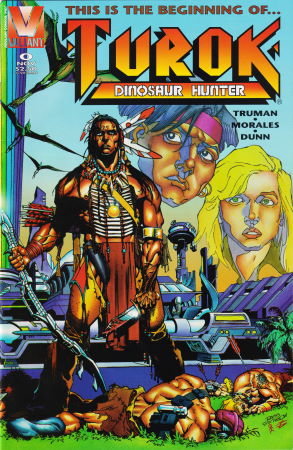
Turok tells all.
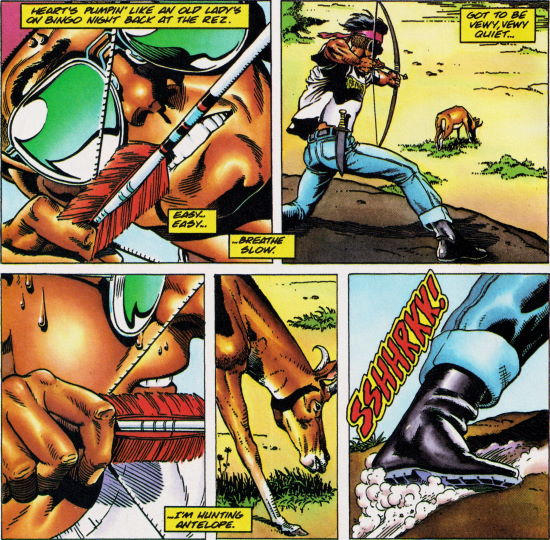
Back in the plains surrounding the Tanoan Flats Reservation, Andy is putting in
some hours behind the bow, hoping to score himself a pronghorn as his first
kill... but the creature hoofs it before he can make the shot. Well, they won't
be eating tonight.
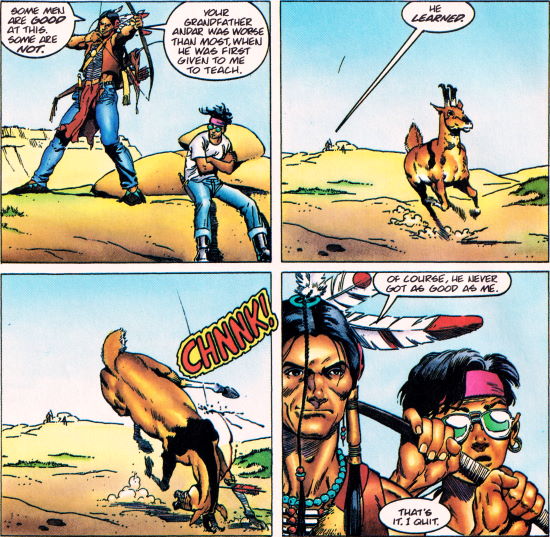
Andy is quick to make excuses — if he had his gun, or if he wasn't wearing
boots, this'd be so much easier, but Turok is adamant to teach his apprentice
the old ways. He made a promise to Andar that his grandson would receive the
same training he did, and they'll remain on the plains for weeks if he has to.
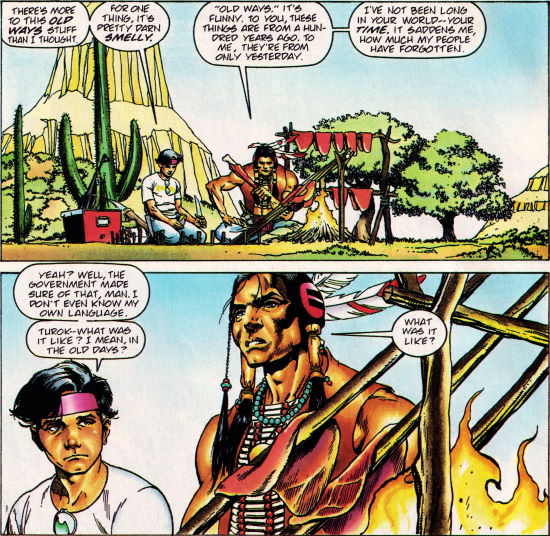
It's not all about awesome archery. Skinning and cooking a beast is its own
endeavour, not to mention making tools from its hide, be it rope, leather, or in
Andy's case, moccasins. The American outlawing of Indigenous cultures has done
a number of Andy's own native identity, and he's curious to know what life was
like in Turok's prime.
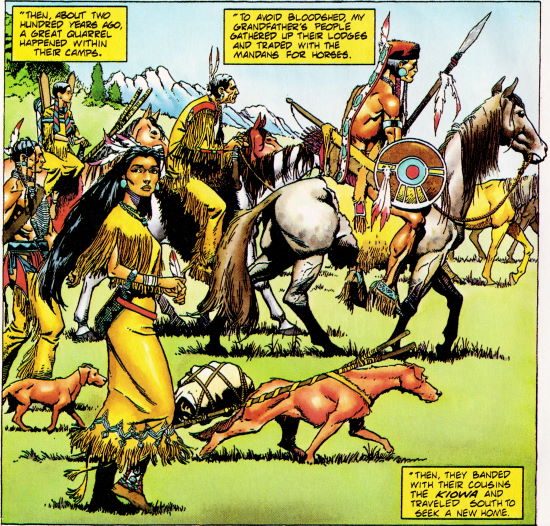
Who's up for a history lesson? What follows is as much the origins of Turok's
character as it is a dramatisation of the life of the Indigenous people of the
1800s. Turok's grandfather was among the Cataka, before splitting off and
travelling south with the Kiowa, where they banded with the Apache. While his
tribe moved on, their family stayed, having made a new home with the people, now
the Kiowa-Apache; they bore a son, Stone, who himself became a father...
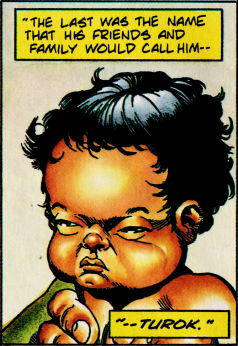
... and that child was Turok, the son of Stone.
Turok would grow up to make a name for himself as an incredible hunter, but also
a reputation for his increasing world-weariness: alcohol-pushing Mexican traders
had soured him and the tribe on ever interacting with outsiders again. They
relocated their settlement to somewhere far more isolated, but Turok took this
isolationism to heart, becoming distant even from his peers and loved ones.
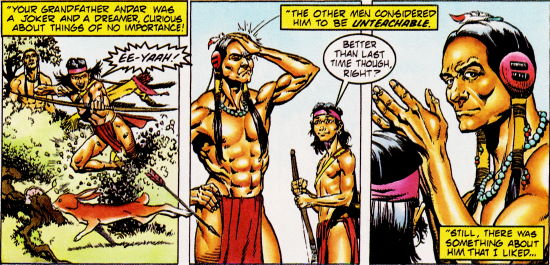
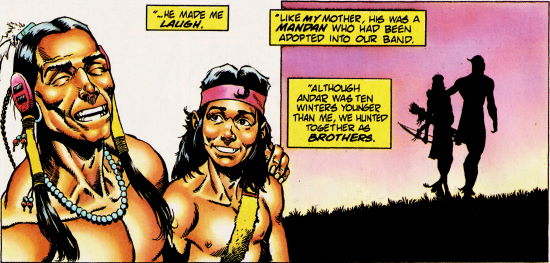
To give him new responsibilities, and to remind him of the joys of life, they
entrusted him with mentoring the young Andar. Although a hopeless student, he
reignited the spark of life within him, and the two remained close companions
even after Turok's status rose after protecting the tribe from enemies.
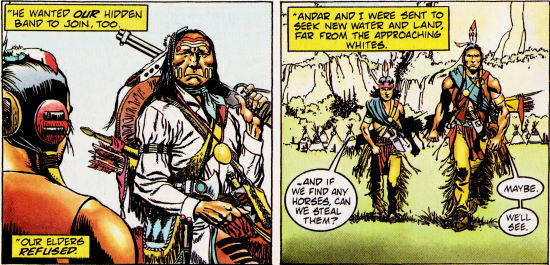
Things were soon to change. Satanta, the renowned Kiowa war chief, came seeking
allies in his efforts to fight back against the white colonialists. The tribe refused to
participate, and fearing invasion of their land, sent Turok and Andar on a
mission to find new settling grounds.
We saw back in issue #17 how Turok's pre-Lost Land history has been tweaked in the Valiant continuity — the Son of Stone comics repeatedly state they "lived some hundreds of years before the coming of the white man to America", and their only interactions on the surface were among fellow tribes. The Valiant storyline bumps them up to the mid-1800s, based on Satanta's appearance, and the Turok: The Hunted miniseries would narrow it down to within the decades leading up to the American civil war. Turok hardly knew peace before he got into the dinosaur-hunting business, from the looks of it.
Speaking of, Turok and Andar's journey found them in the Carlsbad region of New Mexico, where they followed an ominous cluster of bats — "all the bats in the world!"...
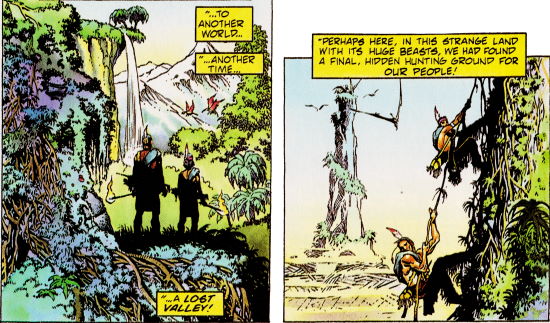
... and found themselves in the Lost Land. They searched for years, but not once
did they make a safe return to their own world. We're very familiar with this
part! And we're not even halfway through covering them all!
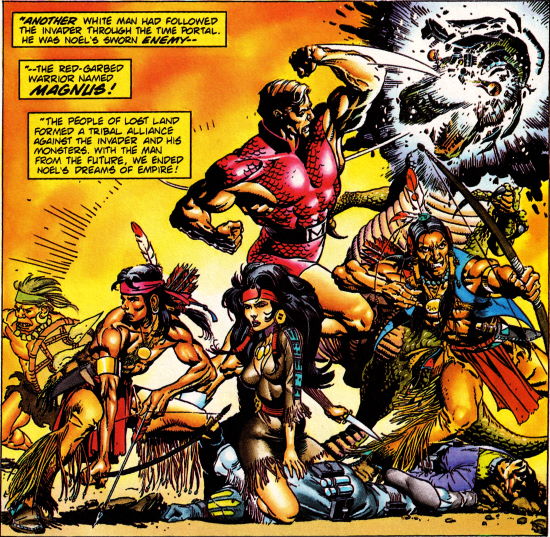
Now a man,
Andar settled with Sharma, the daughter of Keth the picture maker,
and at long last our two heroes parted ways, their lives now leaded on separate
journeys. They briefly reunited when Dr. Laszlo Noel
invaded the Lost Land, Andar eager to protect his new family... but this would be the last time Turok
ever saw his trusted companion.
It puts Andar's lusting over Willow in a different light when we know he's
hooked up and probably already had a kid by this point. Nobody said he was an
upstanding family man. He's had no one to teach him what's off the table!
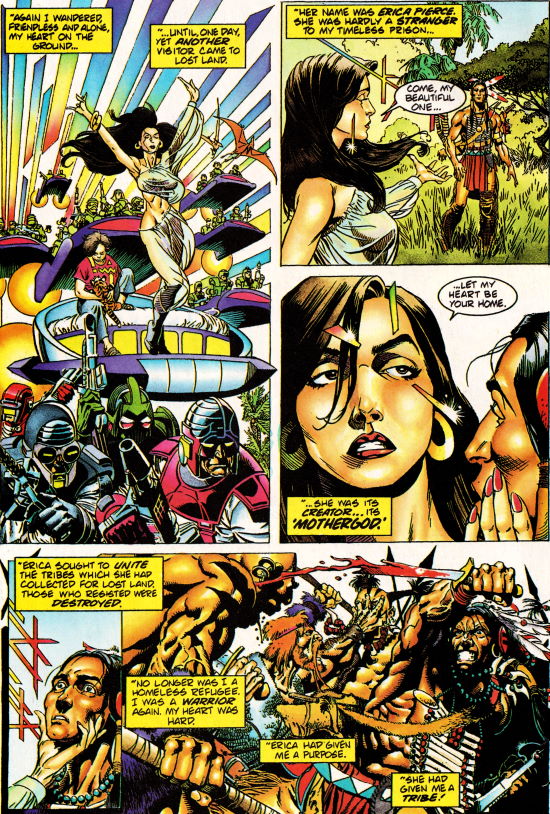
Following this: Mothergod and her plans for
Unity, as we've addressed countless
times so far. We've long awaited answers on just why Turok fell under the
wing of such a callous, murderous despot, and his desperate desire to belong and
feel whole again seems to be the excuse given this time.
Turok's phrasing suggests he took Mothergod at her word that she created the
Lost Land, but to me it implies she saw herself as its sculptor, creating her
new empire from its bedrock outside of linear time. Apparently Solar made the
Lost Land back in The Chaos Effect when he dunked the bad energy through
a time arc? I've said it before how this stuff makes my head spin. The less we
address it, the better.
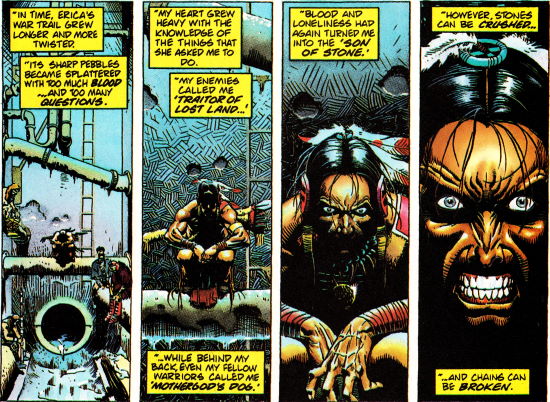
Even this new servitude wore thin once Turok realised what he had become, and
sometime after his encounter with Archer and Armstrong, he turned his back on
the enchantress. He threw his hand in with X-O Manowar and the other heroes from
across time, fighting against Mothergod's wicked dominion. After that, the land
collapsed and he was sent hurtling into the future, our modern day...
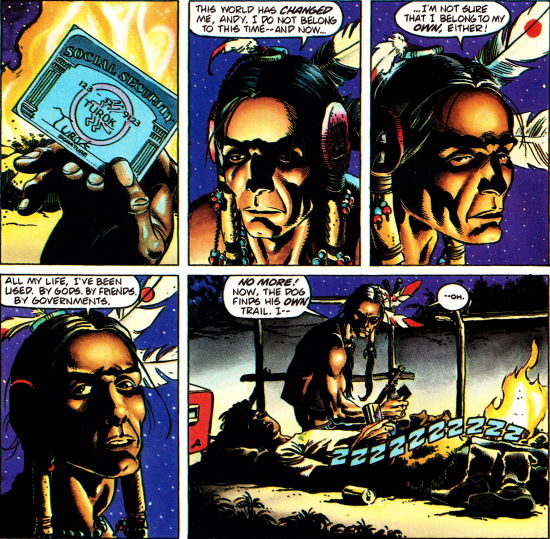
... and here we are now. The Lost Land has since become accessible again via
mysterious portals, and Turok hopes one day he may find one that leads back to
his own time, his old plains... but even then, he doesn't know what time he
considers his own anymore. He has been exposed to so much in the past, present,
and wherever the Lost Lands represents on a calendar.
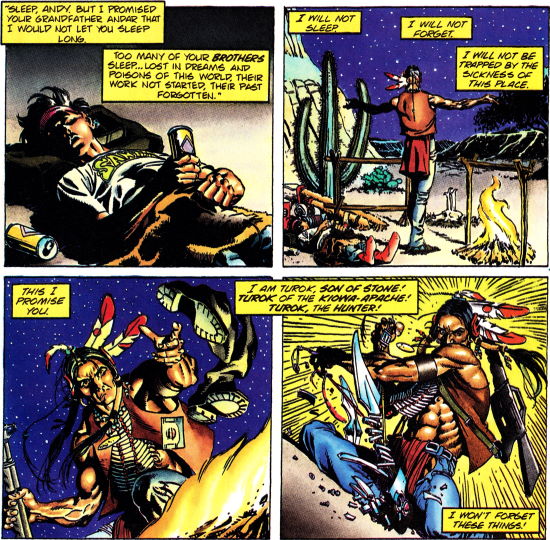
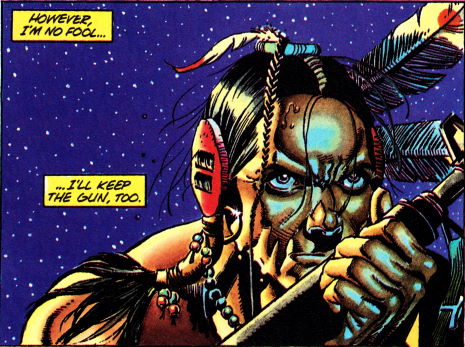
It's time to cast aside old things. Turok banishes his social security card to
the fire, and destroys Mothergod's bow; objects representing his subservience.
He's determined to forge his own path; he will keep his spirit strong, and not
forget the ways he and his people have been used.
A perhaps long-overdue recap of Turok's history -- the book was first mentioned
way back in April 1994 in Comics Scene #41 and slated for a "summer '94"
release, before finally hitting shelves in November 1995. Written and drawn by
the 'true' team of Tim Truman and Rag Morales, it helps set a somewhat
definitive tone to our hero's topsy-turvy journey so far. One man's quest to
find his place in the world, one that's forever changing and stacking the deck
against him. It does play up his moody loner side, but it makes it clear how
good it was to have Andar in his life, complete with allusions to panels and
covers from the Gold Key comics.
It's also the first story in a long time to properly address Turok's heritage, his culture, his birthplace. Tim Truman puts in the work to stay true to historical events and Indigenous customs; it might not mean much to folks who aren't history nerds, but it's great seeing the effort put in to show the authentic relations and travels between tribes at the time, and the encroaching threat of colonialism.
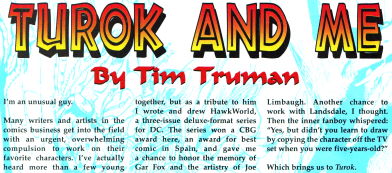
Although there's still a good chunk of Valiant's Turok to go, the book
carries a certain air of melancholy to it. That feeling is aided by the "Turok
and Me" text piece at the end, written by Tim Truman, who explains his
relationship with comics and his childhood favourites. He talks about his
approach to writing Turok, his work on various other franchise revivals, and
takes the opportunity to thank his artists and collaborators, who all offer
their own dedications to friends, family, and researchers. It's a very sweet way
to cap off the issue.