01/April/2020
Updated with some Scans & Bits, including the last remaining chapters of Sly Cooper, the final episode of Mutant Turtles '96, the missing episode of Crash Bandicoot Dance! Jump! Daibouken, a few more scraps of Dr. Mario-kun and Shogakukan's Sonic the Hedgehog, and all but the intro of the short-lived Advance Wars manga.
Under the cut: waffling about the story of Bomberman games, and the one story that actually made a good impression on me. Riveting stuff, I know.
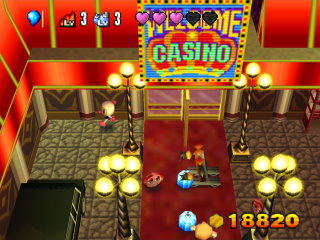
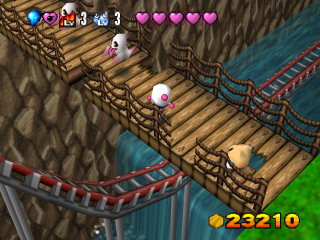
I finally played and finished Bomberman 64: The Second Attack! a couple
of months ago; as that one guy who's mad about Bomberman, it's kind of been my white
whale. Despite being forever hyped about it as a young'un, the game
never saw a
European release -- no doubt because of Nintendo no longer publishing
Hudson's games at the time -- and Vatical Entertainment, who published this and
Bomberman Max, evidently didn't bother exploring options across the pond;
that meant Europe got Bomberman Max 2, but never the debut. That's an
anecdote in itself -- at the time I saw Max starring in his own game and
Bomberman Generation painted him as this dude cooler than the starring
character, and I thought, is Hudson trying to push out their own mascot? But I
digress!
European Nintendo 64 consoles are practically useless for
playing imports, and even with access to emulation it took a fair while before
The Second Attack! became a pleasurable experience. It's rife with
graphical quirks -- while Glide64 works a treat on the first Bomberman 64, on
this one it renders certain objects as not just invisible, but see-through,
displaying chunks of the skybox in their place! This made Planet Horizon a nightmare
until I got it resolved using the Jabo Direct graphics plugin, which adequately
displays the game's architecture as intended.
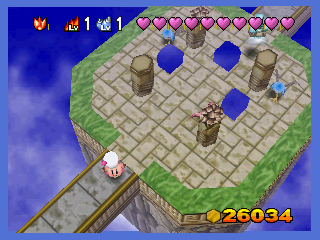
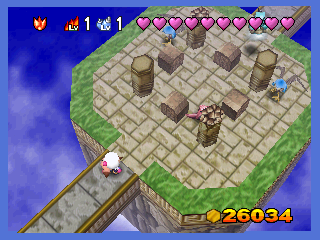
(Glide64 / Angrylion)
... that is, up until Planet Epikyur, when the final puzzle involves bombing a
statue of Zoniha with the appropriate colour of bomb. The statue doesn't display
the correct colour with this plugin; I just fell back on the Angrylion graphic
plugin and Static Interpreter RSP, which from my experience is nigh-flawless in
hardware accuracy, but also a bloody resource hog. You only need it for that one
room, and the order might be predetermined for all I know.
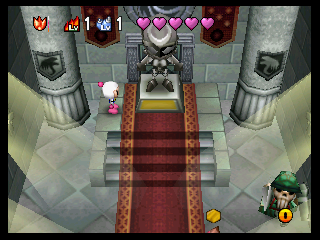
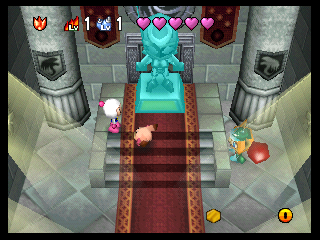
(Jabo / Angrylion)
Oh, and the game also has a strange controller glitch where
you'll arbitrarily lose the ability to move left and right on the analogue
stick. This seems to happen randomly during any screen transition, be it between
rooms, menus, or even cutscenes. You can still use the D-Pad, but the game has
full 3D movement unlike the 8-direction guff in its predecessor, so it stinks to
lose it. I've seen
some
solutions suggested, but I've yet to experiment to see if it's isolated to
certain plugins or emulators. The best I could do was just make frequent
savestates and reload them if it occurred.
ANYWAY!
The Second Attack!
feels like something that's been held over my head for years, it's eluded me
this long. So much of the
series' online fandom has centred almost exclusively around this game; people
treating its one-and-done cast of Lilith, Rukifellth, and the Astral Knights as
cornerstones of the Bomberman universe. Stacks of fan art and fanfiction
(probably just from the same few people, mind) focused
exclusively on their exploits, with the titular character's input at a bare
minimum, if present at all.
It was more than a little frustrating to see what fans were creating for a comparatively niche franchise like
Bomberman... and everyone -- everyone! -- was writing about
the one game I hadn't played. It's the kind of thing that might fuel a
petty vendetta against the game!
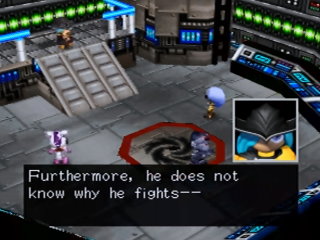
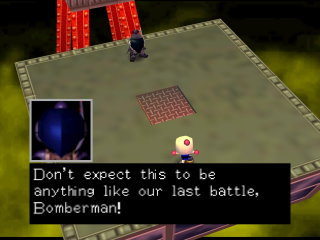
But having finally played it, I can see why. While Bombeman remains a mute cipher given agency by supporting players Pommy and
Lilith, the cutscenes focus largely on the baddies. We see the catty byplay
between the seven members, offering insight to possible inner allegiances or
distrust. They all boil down to basic anime stereotypes, but it's the most
character writing the series had ever had in English at this point! The last game introduced
3D cutscenes, but all byplay between the villains was pure conjecture; you only
had their battle cries to denote any personality.
From a gameplay perspective, it makes for lousy bosses. The Astral Knights are all humanoids who play by the same rulebook, with the only meaningful difference between them how bullshit their elemental attacks are and the length of their invincibility frames. Bomberman 64's boss fights were an equal mixture of traditional Bomberman battles, equipped with special gimmick attacks, and huge arena-filling threats, from huge monsters to heavily-armed war machines. Variety is that game's middle name.
From a story viewpoint, however... it's actually a refreshing
change of pace. As minor as the Astral Knights are in the grand scheme of
things, it's nice to feel like you're fighting people and not just
arbitrary bosses. Despite their bickering, they all loyally serve the grand
villain... or so it seems. It turns out all of them, including their master,
Rukifellth, are not 100% themselves, either under mind control or possession or
what-have-you.
It's perhaps the one story in the entire Bomberman franchise where, by
the story's end, the world is in a better place than it was at the start. Not
only does Bomberman free the planets from the black hole, but all the villains
who had been killed are brought back to life, those possessed by the agent of
chaos are reunited with one another, and the universe-threatening angel
reassesses its judgment. Everyone lives happily ever after, and they continue to
live in a new, adventure-promising status quo.
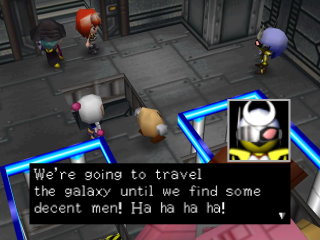
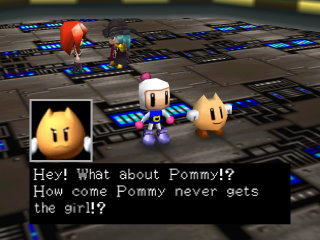
I can't say I paid a great deal of attention to the story, and
the final challenges were proper bullshit, but the ending where everyone got to
walk away happily to new pursuits felt... heartwarming? All the dead characters
reviving under flimsy pretences was almost certainly a cop-out, but I won't deny
it was nice to see a game end so positively, and have the wordage to spin it in
such a way.
For such a cutesy franchise, many of the Bomberman games end with the day being
saved... and oodles of destruction left in its wake. I mean, fair enough, we are
dealing with high-calibre explosives, but when the end result is little
more than the status quo being restored, its a bit like, why bother, y'know? We
aren't bettered by the experience, we just killed the dudes who incited the
situation. Some examples:
Bomberman 64: The Maskers steal the Omni Cube from Sirius and raze Planet Bomber with it, having carved chunks out of four other planets already. By the story's end all but one of the new players are dead, both of the baddies' fortresses and their denizens are destroyed, and nothing is said of the fates for the planets that have already been harvested. "I did it!"
Bomberman Generation: Mujoe and the Crush Bombers kill and steal to get their hands on the Bomb Elements. The Crush Bombers are outright killed in their fight with Bomberman. Mujoe escapes to fight another day, but after all this ruckus just to acquire them, the macguffins scatter into space. The whole story might as well be for naught, as the Bomb Elements are used for nothing but tyranny and destruction.
Super Bomberman R: Ostensibly a happy ending as the Bomberman Brothers are reunited with their long-lost brainwashed siblings... but while under Buggler's command, Plasma Bomber raises some valid questions regarding their position in an organic society that seemingly has little regard for the lives of robots. The moment he's freed from Buggler's influence, all such questions vanish and are never addressed again. To be fair, Buggler's trying to turn into a blackhole or some cobblers, so there's probably no time for sociological debate.
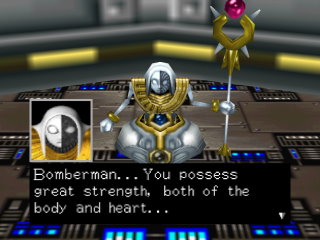
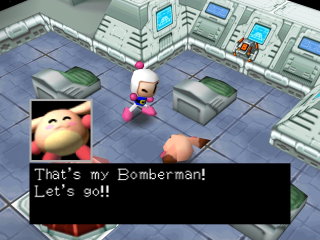
In all fairness, Bomberman 64 is the only one of those to
take itself faintly seriously; Generation and R present themselves
akin to Saturday morning cartoons (or children's anime, hurf), so taking them at
face value is only expected from the absolute hairiest of nerds, like the
webmaster of a Bomberman fansite or something.
I guess it boils down to asking, what does the hero accomplish that isn't simply
undoing the baddies' actions? "Villains act, heroes react" is a recurring trope
in storytelling, and a perfectly understandable one in video games especially.
My beef lies in how more often than not it's simply restoring the status quo,
only all the interesting characters are killed off. Not that Bomberman is big on
continuity, but the Crush Bombers could've been compelling if their art
design weren't the greebliest thing on the planet they were in a game
with more than one sentence of story!
The Second Attack! arguably fits under the same banner, though --
Bomberman does very little that isn't undoing what the baddies set in motion --
but just by virtue of allowing characters to talk about stuff, it makes it feel
that much richer. Neither faction sees completely eye-to-eye on certain things,
even when they are under mind control, so it feels like a story of individuals,
rather than a black-and-white chess board.
Anyway, The Second Attack! is interesting. Definitely not what I'd expect from a sequel to Bomberman 64, but I can understand where it's coming from. I might waffle about that sometime, maybe when I cover it on the shrine. That intro stage can go to hell, though. Most boring piece of shit on the planet. Don't start games in prisons, people! Or graveyards! Or sewers! Save that crap 'til level 5 at least, and glam it up a bit while you're at it!