Apr
2020
Dinosaur Hunter Diaries #021: The Angry Mountain
Turok: Son of Stone #14
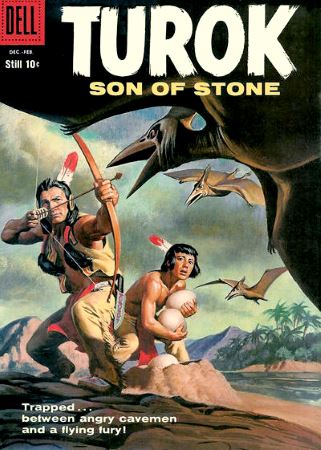
Turok and Andar put their feet to the fire to save a kind old man.
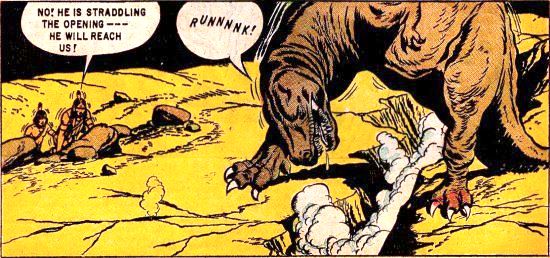
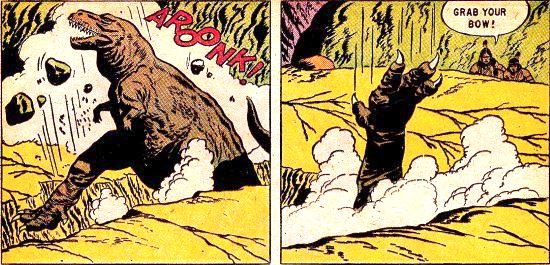
Our heroes are in a dill of a pickle — a slobbering honker hankers for their
flesh, and the earth trembles beneath their feet! The earthquake takes care of
the dinosaur problem, but they're still left on unsafe ground.
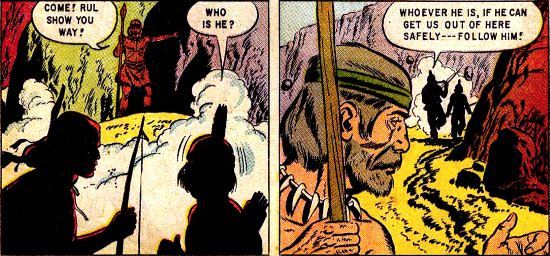
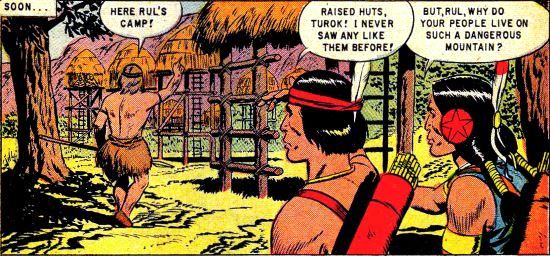
A stranger happens by and takes them to the safety of his camp, a village on
stilts built on the slope of the mountain. The stranger is Rul, the chief of
this village, and he claims the area has been safe for generations; the volcanic
activity from his grandfather's time has only aided the growth of fruits and
nuts. They're doing pretty well, all things considered.
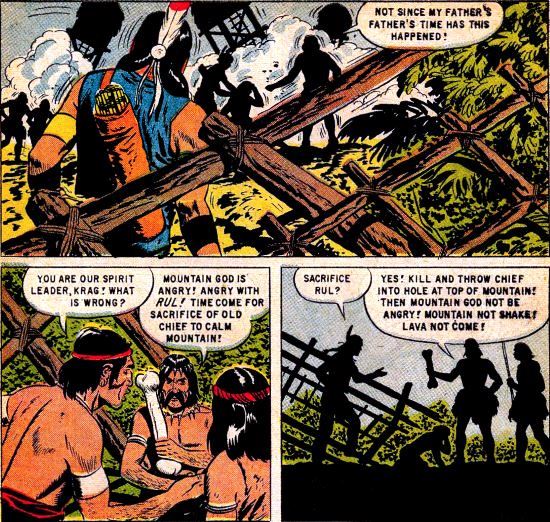
Until an earthquakes hits their side of the mountain and knocks everything down.
Krag, the spirit leader, demands the immediate sacrifice of Rul to appease the
earthquake, because his dumb ideas are the closest thing they have to WikiHow in
this age. Turok and Andar object to the practise but get clobbered by the mob;
Rul submits to his fate, and is carried away.
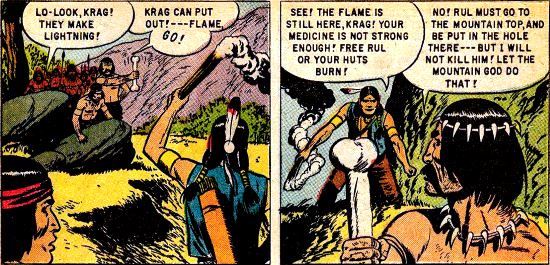
The two follow their trail and encounter Krag, threatening to burn their village
down to save Rul — he saved their life, it seems only fair to save his! Krag
might not have the 'medicine' to put out their fire, but Rul's fate is not in
his hands — all he did was stick him up on the mountain, and what happens
afterwards is his problem.
You'll have seen the term "medicine" come up a lot in the stories so far, and it'll remain in use throughout the entirety of Son of Stone, a staple in any old-timey media featuring Indigenous characters and cultures. The actual definition is kind of muddy and rarely clarified; it isn't helped not just by the differing use of "medicine" between modern English and the Indigenous connotation, but the omnipresent appropriation of native customs and folklore for ulterior motives.
The Indigenous use of "medicine" isn't "take two and call me in the morning," but more in the realm of spirituality and life energy. It has different connotations between cultures, and I am in no way qualified to explain it, as one would need to properly acknowledge the Indigenous lifestyle and sensibilities to get a handle on how it all comes together.
There are many words for it, hailing from the many Indigenous languages and customs, including the previously discussed
"Manitou" of Algonquian culture, or the Wyandot term "Orenda" or "Arendi"... but
in English it all falls under "medicine". Blame the French.
Cowboy media would pluck so-called native lingo for their own ends, and "bad
medicine" became a synonym for the likes of "bad news", "lousy luck", "trouble",
and so on.
The writers of Turok: Son of Stone, having cut their teeth on
fare like The Lone Ranger, also retain this definition. While Turok and various tribes of Lost Valley will use the term as an all-purpose moniker for 'power', be it physical strength or what the cavemen believe to be magic, they also frequently use the word in the context of luck or fortune, or even just "bad juju".
It's a term with a lot of baggage and meaning to it, one that's hard to convey without understanding the rest of the cultural thinking behind it. The pages of Walking Crow and Jean Wolf offer deeper explanation on the subject of medicine and medicine men — though, again, I can't vouch for how accurate it is to all definitions. Like I said, this stuff has a habit of getting co-opted by hippies and Christians. As such, it's unfortunate in the context of Turok it's devolved into a catch-all impetus for the locals to act maliciously, or even a pithy one-liner when our heroes' enemies eat shit.
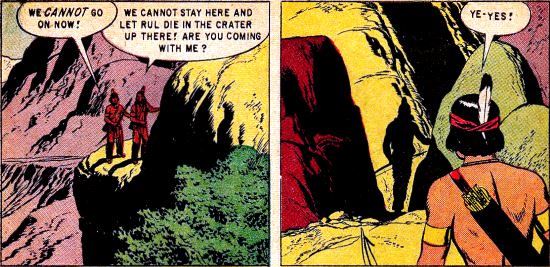
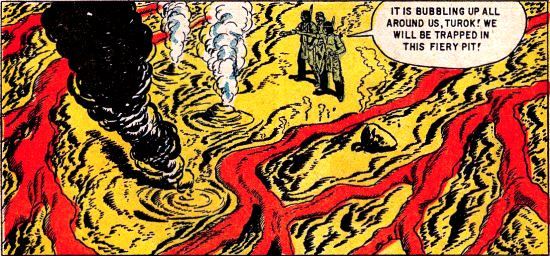
Turok and Andar scale the mountain regardless, and rescue Rul from his bonds just as the
volcano erupts. Lava oozes above the surface, cutting off the way they came.
They clamber up the crater and down the other side, saving them from the burning
gunk... but who'll save the village from the lava? Krag, you're the new leader.
What's your plan of action?
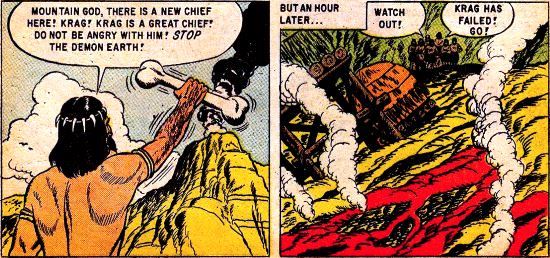
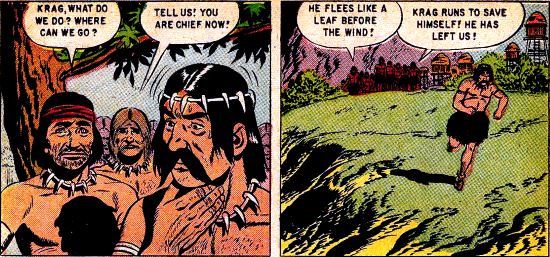
Krag's looking out for number one, but what about the rest of us?
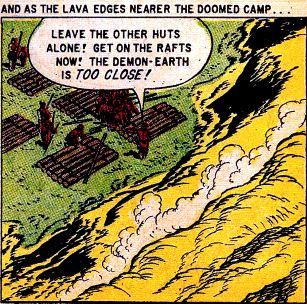
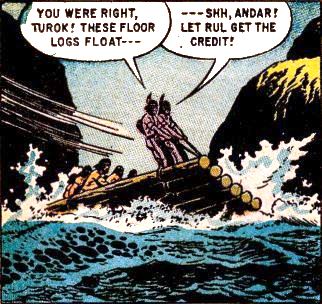
Rul and his saviours return to the village, armed with a hare-brained scheme: if
they cut the floors from their stilt-houses, they can use them as toboggans to slide
down the mountain to safety! It works exactly as Turok planned, but he won't
tell; let Rul have his win.
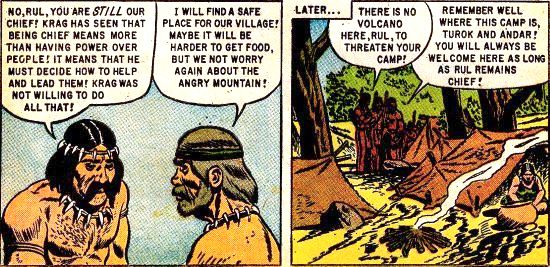
Krag comes slinking back, having learnt a valuable lesson about leadership, and Rul's reign is
reinstated as he helps the tribe set up camp, far from the angry mountain.
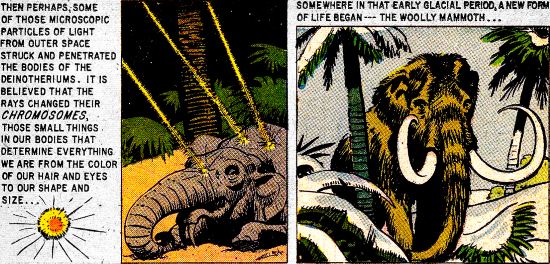
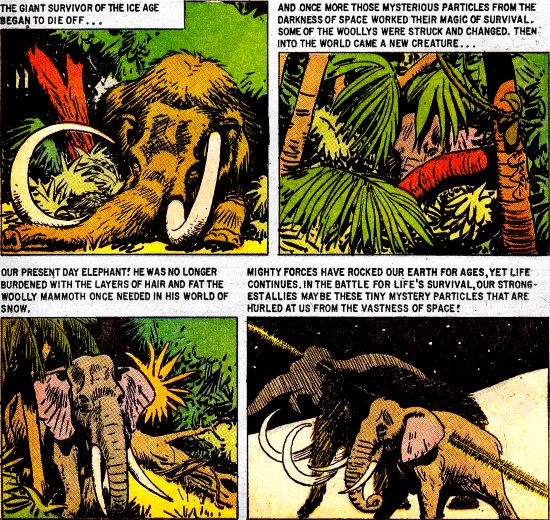
Young Earth fills the pages by telling us Secrets of the Stars! What's really
a tale about the evolution of the deinotherium into the modern elephant, is
instead framed as the result of "microscopic particles of light from outer
space" mutating their chromosomes.
It sounds like hokey baloney of the
highest horse hockey,
but is this how you had to address evolution in the 1950s? Was the subject less
controversial if it was blamed on outer space shenanigans instead of held in
contrast to intelligent design? I've
no idea. If nothing else, you don't often hear evolution framed in this way...
though it's just as easy to say I can evolve into a sightless creature through
interstellar microwaves, when I really shouldn't be looking directly at the sun.
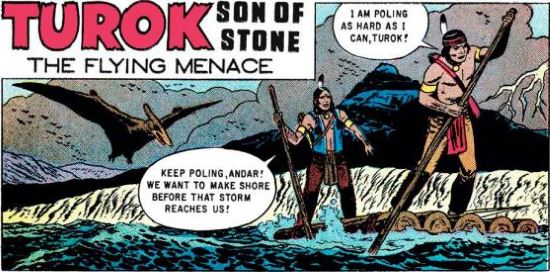
In the middle of a storm that threatens to capsize their raft, a
pteranodon keeps hounding our heroes. Turok snipes it with an arrow before they
reach land, hoping the locals will let them share their cave...
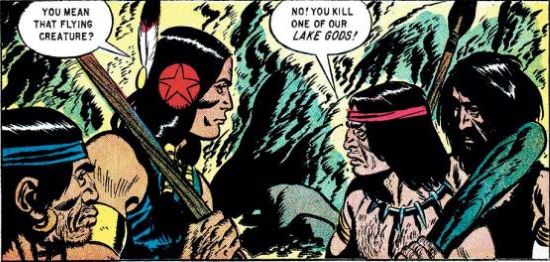
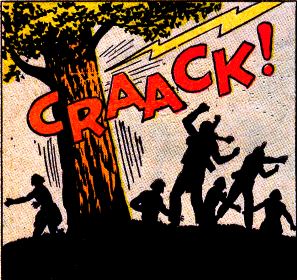
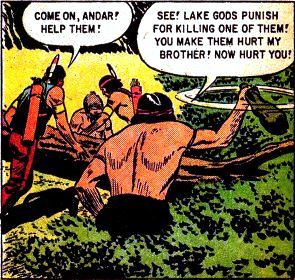
... but they object to the sight of the dead beast. That's one of their gods
they've just slaughtered! They believe the pteranodons emerge fully-formed from
beneath the waters, though Turok's attempt to convince them otherwise fall on
deaf ears -- especially when an unlucky lightning strike hits a tree and nearly
squashes them. Surely that's a sign the gods are unhappy!
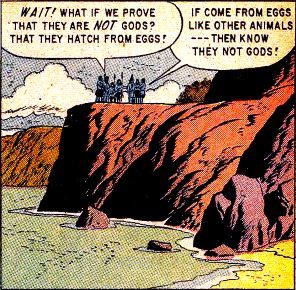
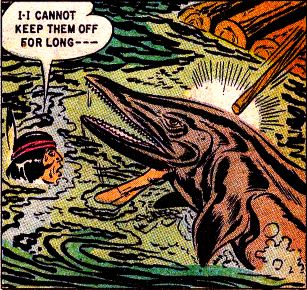
In an attempt to quell their bloodlust, Turok volunteers bring them back a
pteranodon egg, to show they're no more than common animals. The only exit is
through the village, so it's either this or get sacrificed. They set out on
their raft again, and get clobbered by a school of stenoptergius.
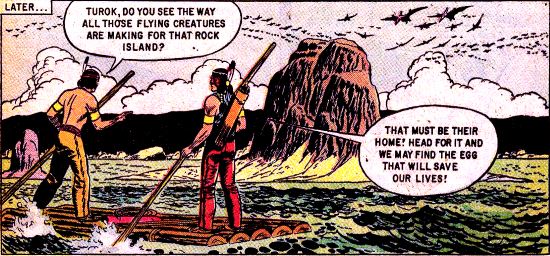
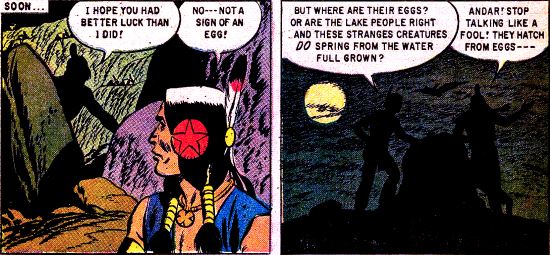
They find an island thriving with pteranodons, but after scaling its cliff and
spending the entire day scouring for eggs, they come out empty-handed. Turok
deduces this is only a roosting island, where fully-grown pteranodons retreat to
for some R&R.
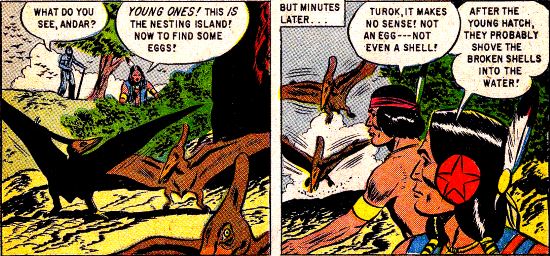
The next morning they sail their raft to a neighbouring island, and find a beach
crawling with widdle baby pteranodons! But they're still no closer to solving
the mystery. Where do they lay their eggs? Do they hatch from eggs? Were the
lake tribe really on they money believing they birthed from the ocean...?
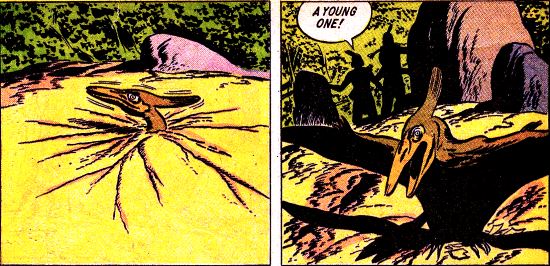
... oh! Well, that answers that: like the brontosaurus they encountered
recently, the pteranodons bury their eggs in the sand and let their heat
absorption do all the hard work.
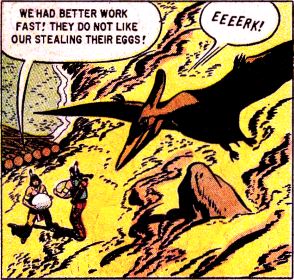
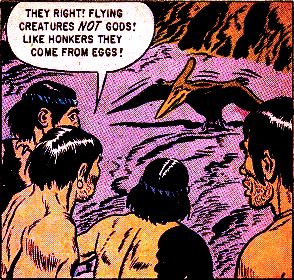
They gaffle a few eggs and haul ass back to the tribe, and they watch the eggs
until sunset. Just when it looks like the tribe are ready to have their heads,
the eggs hatch, cracking their illusion of the beasts as gods of the sky. Turok
and Andar are free to go.
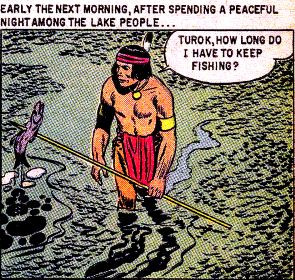
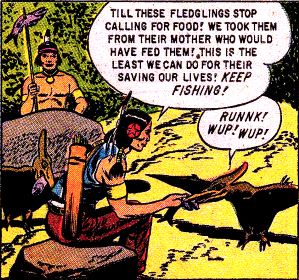
But before they do that, they've got work to do: those baby pteranodons have an
appetite!
I love this. Any excuse for Turok and Andar to interact with baby
animals has me squealing like a buffoon. If we can just pretend the two have
little juvenile beasts perched on their shoulders for the next few stories, I'd
be extremely satisfied.